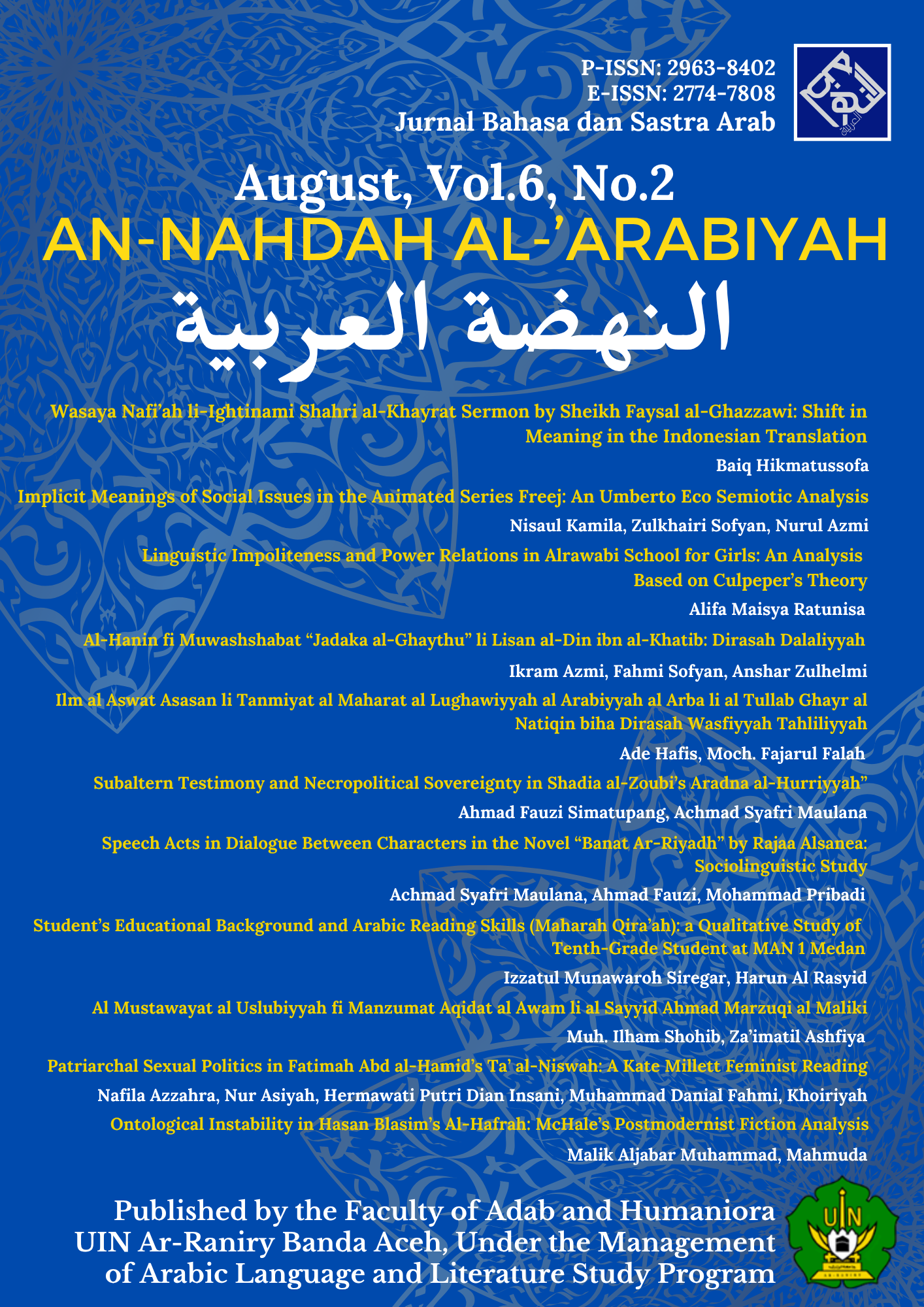
Patriarchal Sexual Politics in Fatimah Abd al-Hamid’s Ta’ al-Niswah: A Kate Millett Feminist Reading
Al Siyasah Al Jinsiyyah Al Abawiyyah fi Riwayat Ta Al Niswah li Fatimah Abd Al Hamid Qiraah Nisawiyyah Inda Kate Millett
DOI:
https://doi.org/10.22373/nahdah.v6i2.10507Keywords:
Kate Millet, Patriarchal, Sexual Politics, Ta' Al-Niswah, Domination, Saudi Women's LiteratureAbstract
Although contemporary Saudi urban spaces are often associated with modernization and women’s increased visibility, literary representations suggest that patriarchal power persists in reconfigured forms. The mechanisms through which this power operates across domestic relations and urban consumer spaces therefore require closer textual examination. This study examines how patriarchal sexual politics is represented in Fatimah Abd Al-Hamid’s Ta’ al-Niswah and how its female characters internalize, negotiate, or resist domination in private and public spaces. Using a descriptive qualitative design within feminist literary criticism, the study applies close reading, systematic note-taking, and textual coding to the novel’s first Arabic edition, published in 2014. Guided by Kate Millett’s concepts of status, role, temperament, interior colonization, and patriarchy as a political institution, the analysis identifies five interrelated categories: coercive sexual subordination, unequal domestic labour, control over women’s bodies and mobility, objectification and stereotypical representation, and women’s internalization, negotiation, and resistance. These dynamics emerge in domestic, marital, occupational, and urban commercial spaces. The study shows that urban modernity does not eliminate patriarchal authority but reconfigures it through consumer culture, bodily regulation, social surveillance, and gendered expectations. However, its conclusions are limited to the novel’s literary representation and should not be generalized to all Saudi women.
غالبًا ما ترتبط الفضاءات الحضرية السعودية المعاصرة بالتحديث وتزايد حضور المرأة، إلا أن التمثيلات الأدبية تشير إلى استمرار السلطة الأبوية في صور معاد تشكيلها. ولذلك، تتطلب الآليات التي تعمل من خلالها هذه السلطة داخل العلاقات الأسرية وفضاءات الاستهلاك الحضرية فحصًا نصيًا أكثر عمقًا. تبحث هذه الدراسة في كيفية تمثيل السياسة الجنسية الأبوية في رواية تاء النسوة لفاطمة عبد الحميد، وكيف تستبطن شخصياتها النسائية الهيمنة الأبوية أو تتفاوض معها أو تقاومها في الفضاءين الخاص والعام. اعتمدت الدراسة تصميمًا وصفيًا نوعيًا ضمن النقد الأدبي النسوي، وطبّقت القراءة المتعمقة والتدوين المنهجي للملاحظات والترميز النصي على الطبعة العربية الأولى من الرواية الصادرة عام 2014. واستنادًا إلى مفاهيم كيت ميليت المتعلقة بالمكانة والدور والطبع والاستعمار الداخلي والنظام الأبوي بوصفه مؤسسة سياسية، حدّد التحليل خمس فئات مترابطة: الإخضاع الجنسي القسري، وعدم التكافؤ في العمل المنزلي، والتحكم في أجساد النساء وحركتهن، وتشييء المرأة وتمثيلها بصورة نمطية، واستبطان النساء للهيمنة والتفاوض معها ومقاومتها. وتظهر هذه الديناميات في الفضاءات المنزلية والزواجية والمهنية والتجارية الحضرية. وتبين الدراسة أن الحداثة الحضرية لا تلغي السلطة الأبوية، بل تعيد تشكيلها من خلال الثقافة الاستهلاكية وضبط الجسد والمراقبة الاجتماعية والتوقعات الجندرية. ومع ذلك، تظل نتائج الدراسة محصورة في التمثيل الأدبي داخل الرواية، ولا ينبغي تعميمها على جميع النساء السعوديات.
Meskipun ruang urban Saudi kontemporer sering dikaitkan dengan modernisasi dan meningkatnya visibilitas Perempuan, representasi sastra menunjukkan bahwa kekuasaan patriarki tetap bertahan dalam bentuk yang telah dikonfigurasi ulang. Oleh karenanya, mekanisme bekerjanya kekuasaan dalam relasi domestik dan ruang konsumsi urban memerlukan telaah tekstual yang lebih mendalam. Penelitian ini mengkaji representasi politik seksual patriarkal dalam novel Ta’ al-Niswah karya Fatimah Abd Al-Hamid serta cara tokoh-tokoh perempuannya menginternalisasi, menegosiasikan, atau melawan dominasi patriarki di ruang privat dan publik. Penelitian ini menggunakan desain deskriptif kualitatif dalam kerangka kritik sastra feminis melalui pembacaan, pencatatan sistematis, dan pengodean tekstual terhadap edisi pertama novel berbahasa Arab yang terbit pada 2014. Dengan berpedoman pada konsep Kate Millett mengenai status, peran, temperamen, kolonisasi internal, dan patriarki sebagai institusi politik, analisis menemukan lima kategori yang saling berkaitan: subordinasi seksual koersif, ketimpangan kerja domestik, kontrol atas tubuh dan mobilitas perempuan, objektifikasi dan representasi stereotip, serta internalisasi, negosiasi, dan perlawanan perempuan. Dinamika tersebut muncul dalam ruang domestik, perkawinan, pekerjaan, dan ruang komersial urban. Penelitian ini menunjukkan bahwa modernitas urban tidak menghapus kekuasaan patriarki, tetapi membentuknya kembali melalui budaya konsumsi, regulasi tubuh, pengawasan sosial, dan ekspektasi gender. Meskipun demikian, kesimpulannya terbatas pada representasi sastra dalam novel dan tidak dapat digeneralisasi terhadap seluruh perempuan Saudi.
References
A’la, A. F. (2025). Orientalist discourse in Najib Mahfouzh’s short story Finjanu-Shay: Analysis of orientalism by Edward W. Said. Jurnal Bahasa Dan Sastra Pusaka Cendekia, 1(1), 33–46. https://journal.pusakacendekia.org/index.php/arsa/article/view/4
Al-Bishr, B. (2011). Hind wal Askar (3rd ed.). Dar Al-Saqi.
Al-Hamid, F. A. (2014). Ta’ Al-Niswah. Dar Atsar.
Al-Qahtani, A. (2025). Navigating modernity and tradition: A CDA of Saudi news articles on women’s rights. SAGE Open, 15(3), 1–19. https://doi.org/10.1177/21582440251365752
Al-Sanea, R. (2005). Banāt ar-Riyādh. Dar Al-Saqi.
Alkhalil, S. F. A. (2025). Women’s representations in Saudi Arabia: The case of universities’ online discourses. Cogent Arts & Humanities, 12(1), 2539718. https://doi.org/10.1080/23311983.2025.2539718
Allam, N. (2025). The mahram effect: Gender politics and Saudi Arabia. Democratization. https://doi.org/10.1080/13510347.2025.2524854
Allen, K. R. (2016). Feminist theory in family studies: History, reflection, and critique. Journal of Family Theory & Review, 8(2), 207–224. https://doi.org/10.1111/jftr.12133
Almuthaybiri, A. M. (2025). Breaking the chains: women’s writing against patriarchy in Saudi narratives. British Journal of Middle Eastern Studies, 52(5), 1274–1290. https://doi.org/10.1080/13530194.2024.2421504
AlQahtani, S. M., & Alghamdi, A. K. H. (2025). Unveiling progress: A visual exploration of Saudi women in the workforce. Humanities and Social Sciences Communications, 12, 1401. https://doi.org/10.1057/s41599-025-05081-7
Alshhre, A. M. (2024). Gender in revelations: Unraveling gendered struggles and revisiting the construction of cultural identity paradigms in Badriyah Al-Bishr’s Hend Wa alʿaskar (2006). Women’s Studies International Forum, 106, 102980. https://doi.org/10.1016/j.wsif.2024.102980
Aulia, S. S., Marzuki, Suyato, & Arpannudin, I. (2024). Women in gender equality movement: a systematic literature review. Frontiers in Sociology, 9. https://doi.org/10.3389/fsoc.2024.1432383
Beloskar, V. D., Haldar, A., & Gupta, A. (2024). Gender equality and women’s empowerment: A bibliometric review of the literature on SDG 5 through the management lens. Journal of Business Research, 172, 114442. https://doi.org/10.1016/j.jbusres.2023.114442
Bray, A., & Colebrook, C. (1998). The haunted flesh: Corporeal feminism and the politics of (dis)embodiment. Signs: Journal of Women in Culture and Society, 24(1), 34–67. https://doi.org/10.1086/495317
Bush, S. S., & Zetterberg, P. (2024). Gender equality and authoritarian regimes: New directions for research. Politics & Gender, 20(1), 212–216. https://doi.org/10.1017/S1743923X22000460
Cahaya, S. (2026). Deconstruction of Patriarchal Construction: An Islamic Gender Analysis of Laysa Lahā Makān fī Al-Jannah. An-Nahdah Al-’Arabiyah, 6(1), 101–113. https://doi.org/10.22373/nahdah.v6i1.8870
Christianson, M., Teiler, Å., & Eriksson, C. (2021). “A woman’s honor tumbles down on all of us in the family, but a man’s honor is only his”: young women’s experiences of patriarchal chastity norms. International Journal of Qualitative Studies on Health and Well-Being, 16(1). https://doi.org/10.1080/17482631.2020.1862480
Dai, Y., Zhu, Z., & Guo, W. (2025). The impact of advertising on women’s self-perception: A systematic review. Frontiers in Psychology, 15, 1430079. https://doi.org/10.3389/fpsyg.2024.1430079
Deckard, S. (2024). Social reproduction, struggle and the ecology of ‘women’s work’ in world-literature. Feminist Theory, 25(2), 222–241. https://doi.org/10.1177/14647001231209901
Fajri, A. (2025). Rhetorical study of ideological representation in public discourse: A critical analysis of socio-cultural discourse. Jurnal Bahasa Dan Sastra Pusaka Cendekia, 1(1), 61–71. https://doi.org/10.65427/puscen.v1i1.6
Gqola, P. D., Perera, I., Phadke, S., Shahrokni, N., Zaragocin, S., Satija, S., & Ghosh, A. (2024). Gender and public space. Gender & Development, 32(1–2), 1–25. https://doi.org/10.1080/13552074.2024.2376976
Hasri, I., Berdan, A., Mus, I., Trisnady, I. A., & Sumardi. (2025). Samih Al-Qasim’s Poem Kama Nasya’ as a Representation of Palestinian Social Reality: A Sociology of Literature Study. Jurnal Bahasa Dan Sastra Pusaka Cendekia, 1(3), 137–142. https://doi.org/10.65427/puscen.v1i3.17
Kranz, D. (2025). When perceived partner-objectification contaminates women’s self-esteem: On the mediating effects of self-objectification and body appreciation. Current Psychology, 44, 15668–15680. https://doi.org/10.1007/s12144-025-08211-1
Miles, M. B., Huberman, A. M., & Saldana, J. (2020). Qualitative data analysis: A methods sourcebook (4th ed.). SAGE Publications.
Millett, K. (2016). Sexual Politics. Columbia University Press.
Mulyadi, M. I., Shaliha, C. A. A., Jafar, A., Azhari, & Fajri, A. (2025). How Arabic Media Construct Armed Conflict: A Corpus-Driven Concordance Analysis. Jurnal Bahasa Dan Sastra Pusaka Cendekia, 1(3), 114–126. https://doi.org/10.65427/puscen.v1i3.15
Nations, U. (2015). Transforming Our World: The 2030 Agenda for Sustainable Development. United Nations.
Nazar, M., Febrianisa, S., & Karomah, S. (2026). Symbolic Resistance of the Subaltern in Palestine in the Novel Rijāl fī Asy-Syams by Ghassan Kanafani: Postcolonial Approach of Gayatri C. Spivak. An-Nahdah Al-’Arabiyah, 6(1), 1–18. https://doi.org/10.22373/nahdah.v6i1.7792
Nordvik, F. M. (2026). Reforming gender laws: The economic impact for women in Saudi Arabia. The Journal of Development Studies, 62(5), 834–854. https://doi.org/10.1080/00220388.2025.2590455
Putri, Y., & Abshar, U. (2025). Women’s struggle in patriarchal society: Relation of gender, social, and economy in Niswah al-Sūq al-’Atīq by Majid Sulaiman. Diwan: Jurnal Bahasa Dan Sastra Arab, 17(2), 133–147. https://doi.org/10.15548/diwanjurnalbahasadansastraarab.v17i2.2405
Reich-Stiebert, N., Froehlich, L., & Voltmer, J.-B. (2023). Gendered Mental Labor: A Systematic Literature Review on the Cognitive Dimension of Unpaid Work Within the Household and Childcare. Sex Roles, 88(11–12), 475–494. https://doi.org/10.1007/s11199-023-01362-0
Saputra, D., Zulhelmi, A., Anies, S. S., & Rinahayu, N. (2025). Modernisme as a Movement in Arabic Literature. Jurnal Bahasa Dan Sastra Pusaka Cendekia, 1(2), 103–107. https://doi.org/10.65427/puscen.v1i2.14
Sari, A. V, & Wiyatmi. (2021). Sexual politics in fiksimini: Analysis of feminist critical discourse. International Journal of Linguistics, Literature and Translation, 4(2), 110–118. https://doi.org/10.32996/ijllt.2021.4.2.14
Shalaby, M., & Wängnerud, L. (2024). Gender and authoritarian politics: Citizens and elites’ responses to gender reforms. Comparative Political Studies, 57(14), 2263–2280. https://doi.org/10.1177/00104140241283159
Sugihastuti, & Suharto. (2016). Kritik Sastra Feminis: Teori dan aplikasinya. Pustaka Pelajar.
Syarifuddin, Sofyan, F., Trisnady, I. A., Rinahayu, N., A’la, A. F., & Soraya, C. R. (2026). Representing Post-Tsunami Acehnese Identity in Tere Liye’s Hafalan Shalat Delisa: A Stuart Hall Perspective. An-Nahdah Al-’Arabiyah, 6(1), 89–100. https://doi.org/10.22373/nahdah.v6i1.8675
Tijani, O. I. (2019). Is Sadeem Legally Married to Waleed? Islamic Feminism and the Intersection of Culture, Religion, and Gender in Banāt al-Riyāḍ. Societies, 9(1), 4. https://doi.org/10.3390/soc9010004
Wardah, Y. S., & Surur, M. (2025). Gender Discrimination in The Drama Series The Exchange: A Sara Mills Critical Discourse Analysis. An-Nahdah Al-’Arabiyah, 5(1), 129–153. https://doi.org/10.22373/nahdah.v5i1.6543
Women, U. N. (2018). Turning Promises into Action: Gender Equality in the 2030 Agenda for Sustainable Development. UN Women.