PEER REVIEW PROCESS
PEER REVIEW PROCESS
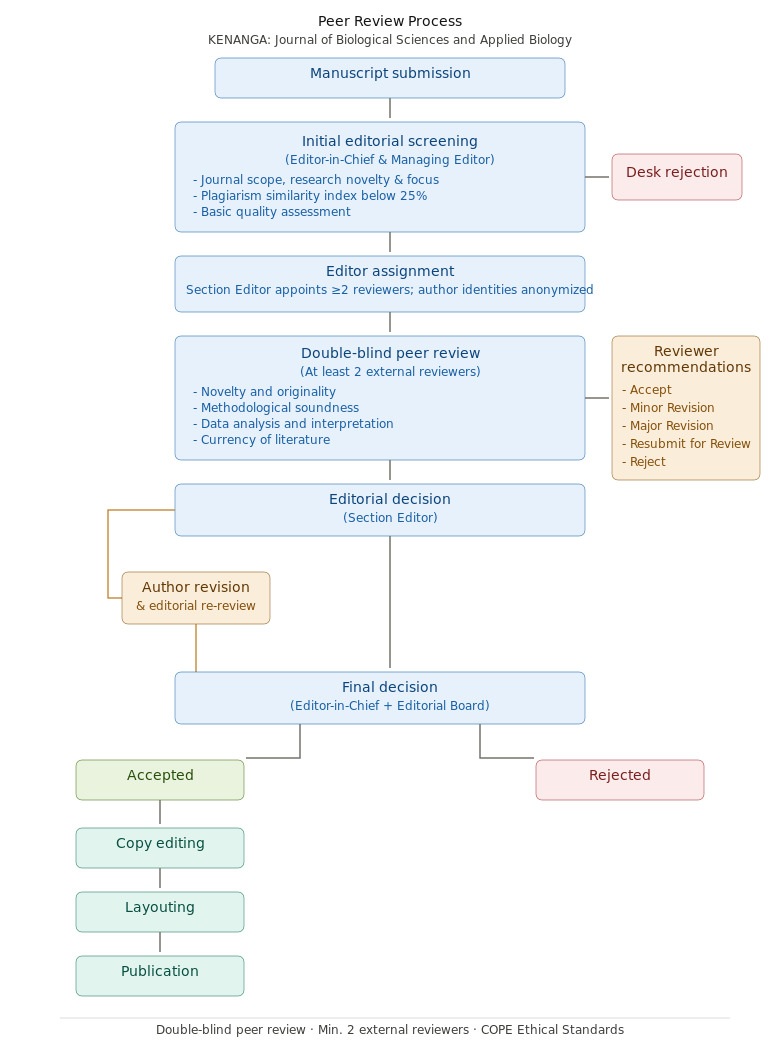
KENANGA: Journal of Biological Sciences and Applied Biology employs a double-blind peer review process, in which the identities of authors and reviewers are kept confidential throughout the peer review process. Each submitted manuscript, including original research articles and review articles, is evaluated by at least two independent reviewers with relevant expertise in the subject area of the manuscript. The reviewers assess the manuscript's validity, scientific quality, originality, and relevance. Accepted articles are published online in either English or Indonesian.
The purpose of peer review is to uphold the integrity of science, filter out low-quality submissions, and enhance the journal’s reputation. This process also adds scientific value to the articles and ensures that the journal maintains high-quality standards.
- Submission Manuscript
Before submitting a manuscript, authors must ensure that it is an original work, has not been previously published, and is not currently under consideration by another journal (no double submissions). Manuscripts must be formatted according to the Author Guidelines and use the official KENANGA Journal template to ensure consistency in citation style, article structure (IMRaD: Introduction, Methods, Results, and Discussion), and the quality of biological illustrations/images.
The submission process is conducted entirely online via the Open Journal Systems (OJS) platform. Authors must register an account as an Author and complete the manuscript metadata fully and accurately. This metadata includes:
- Author Information: Full name (without academic titles), institutional affiliation, and an active email address. The Corresponding Author must be clearly identified.
- Core Content: An article title that accurately reflects the content of the applied biology research, a comprehensive abstract, and relevant keywords to facilitate future indexing.
Documents must be submitted in an editable format (Microsoft Word) to facilitate the substantive editing process in the subsequent stage. After all files and metadata have been uploaded, the author must perform a final check using the Submission Checklist provided by the system. Once the “Finish Submission” button is clicked, the OJS system will send an automatic confirmation email to the Corresponding Author. For detailed procedures, see the KENANGA Journal Submission Guide.
- Editorial Screening and Desk Review
Once a manuscript is received, the Editor-in-Chief or Managing Editor conducts an initial administrative and substantive evaluation. This stage includes:
- Scope Compliance: Ensuring that the manuscript’s topic is relevant to biological sciences and applied biology.
- Plagiarism Check: Conducting a similarity check using Turnitin or iThenticate, with a maximum similarity threshold of 25%.
- Basic Quality Assessment: Evaluating whether the manuscript’s methodology and level of novelty justify its progression to the peer review stage.
Manuscripts that do not meet these criteria will be rejected at the desk review stage to maintain the journal’s operational efficiency and quality standards.
- Section Editor Assignment
Manuscripts that pass the initial screening are assigned to a Section Editor with expertise aligned with the research topic (e.g., Microbiology, Ecology, or Biotechnology). The Section Editor is responsible for appointing at least two competent and independent reviewers. The Editor must ensure that reviewers are from institutions different from those of the authors (cross-institutional) to guarantee objectivity.
The Section Editor manages all correspondence between reviewers and authors through the OJS system until the manuscript receives a final decision. The Section Editor must also ensure that manuscripts sent to reviewers are free from any metadata or identifying information that could reveal the authors’ identities or institutional affiliations.
- Double-Blind Peer Review
Reviewers are tasked with conducting an in-depth evaluation of the scientific aspects of the manuscript without knowing the authors’ identities, and vice versa. Reviews are conducted through the OJS system in accordance with the scientific standards of biological sciences. The main components of the evaluation include:
- Novelty and Originality: Assessing whether the manuscript provides new theoretical or practical contributions, rather than merely repeating existing research.
- Methodological Soundness: Examining the research design, validity of instruments, experimental procedures, and sampling techniques to ensure alignment with established standards in biological research.
- Data Analysis and Interpretation: Ensuring the appropriate use of statistical or analytical methods and verifying that the conclusions are supported by the presented data.
- Currency of Literature: Evaluating whether at least 80% of the references are derived from primary sources (research articles) published within the last 10 years.
Reviewers are required to provide substantive comments in two separate sections:
- Comments for the Author: Containing constructive criticism, suggestions for improvement, and clarifying questions aimed at enhancing the quality of the manuscript.
- Confidential Notes to the Editor: Containing private assessments regarding the manuscript’s suitability, including any concerns related to publication ethics.
After the evaluation process is complete (typically within 2–4 weeks), reviewers provide one of the following recommendations through the OJS system:
- Accept Submission: The manuscript is accepted without revisions.
- Minor Revision: The manuscript requires minor corrections or clarifications.
- Major Revision: The manuscript requires substantial improvements in data, methodology, or discussion before it can be reconsidered.
- Resubmit for Review: The manuscript must be substantially revised and will undergo a new round of peer review.
- Decline Submission (Reject): The manuscript is rejected due to critical flaws or lack of significant scientific contribution.
- Revision and Academic Iteration
Once the Section Editor issues a “Revision Required” decision, the OJS system automatically notifies the Author and provides detailed comments from the Reviewers. The Author is given a standard period of 2 to 4 weeks to address all comments. Authors are required to make substantive revisions that respond to all points raised by the Reviewers.
The revised manuscript, once resubmitted, will be re-evaluated. In cases of major revisions, the Section Editor may return the manuscript to the original Reviewers (second round of review) to ensure that all substantive issues have been adequately addressed. This process may be repeated iteratively until the Reviewers confirm that the manuscript meets the publication standards of the KENANGA Journal.
- Editorial Discussion and Decision
After at least two reviewers have submitted their evaluation reports and substantive comments through the OJS system, the Section Editor conducts a comparative assessment of the reviews. The Editor is responsible for synthesizing the reviewers’ comments to ensure that all feedback is constructive and relevant to the scientific quality of the manuscript.
In cases where there are conflicting recommendations among reviewers (e.g., Accept vs. Reject), the Editor may appoint a third reviewer (adjudicator) or conduct an independent assessment to reach an objective decision. The Editor compiles the reviewers’ comments into clear revision instructions while maintaining reviewer anonymity in accordance with the double-blind peer review policy.
The decision is then communicated to the Author via the OJS system in one of the following forms: Minor Revision, Major Revision, or Decline Submission (Reject). After the final revision stage, the Editor evaluates the revised manuscript along with the revision report. The Editor has full authority to make the final decision:
- Accept: The manuscript is deemed scientifically and technically suitable for publication.
- Reject: The manuscript is rejected if the Author fails to adequately address the substantive issues raised by the Reviewers or the Editor.
- Copy Editing
Once a manuscript has been officially accepted, it is forwarded to the copyediting team. Their role is to correct grammar, spelling, and writing style to ensure compliance with formal academic language standards. They also ensure that references, formatting, and biological terminology are consistent throughout the manuscript.
- Layout and Typesetting
The layout editor is responsible for converting the manuscript into a publication-ready format. Their tasks include formatting the text according to the journal’s template, inserting figures and tables, assigning a DOI (Digital Object Identifier), and setting headers and footers in accordance with publication standards.
- Publication
The final stage is publication by the journal team. The article is officially published on the journal’s website in PDF format, making it accessible to the public. Additionally, the team ensures that the article is indexed in relevant databases so that it can be discovered, read, and cited by the global scientific community.