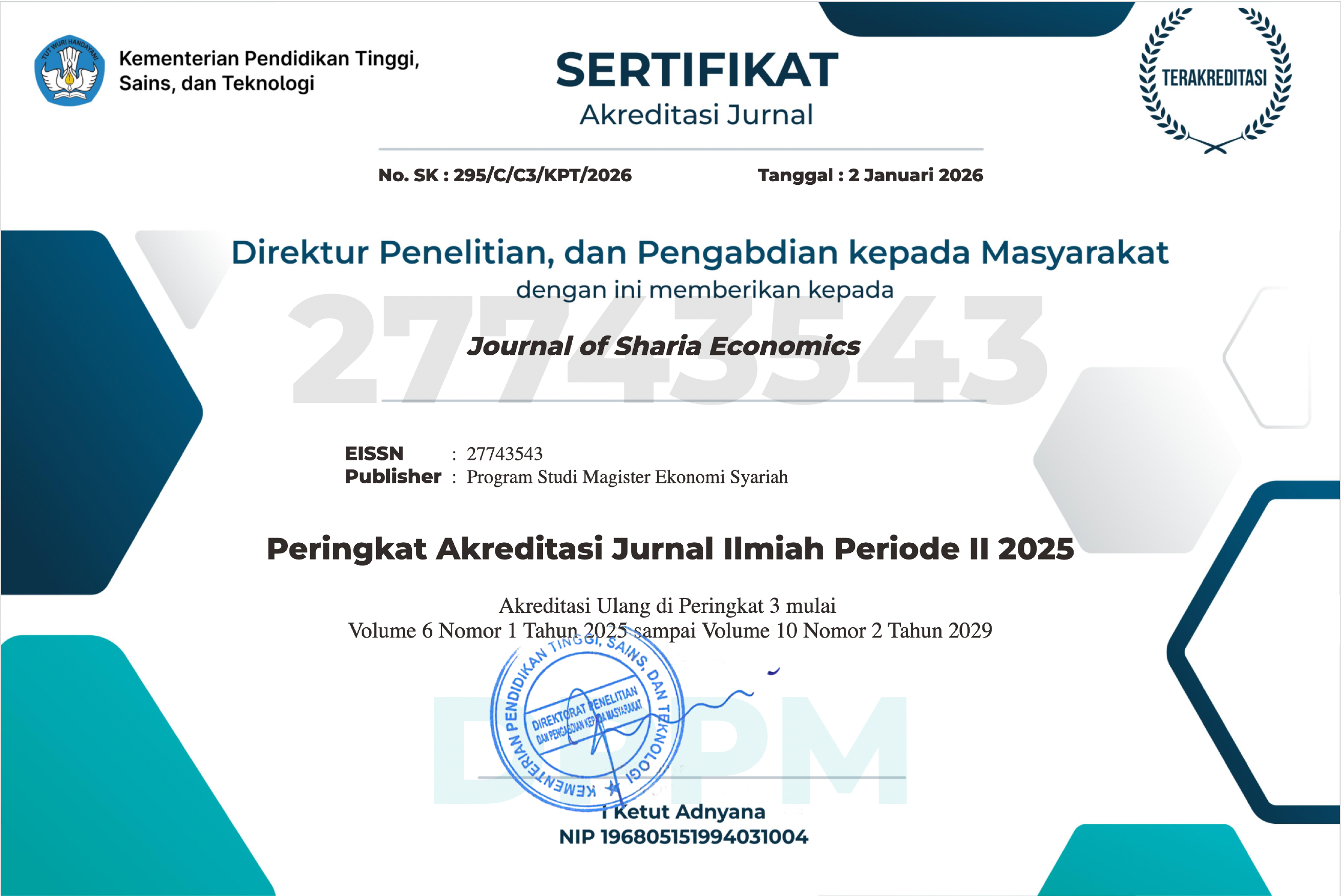
THE MORAL PARADIGM OF ISLAMIC ECONOMICS: PHILOSOPHICAL REFLECTIONS ON TAWHID, JUSTICE, AND SOCIAL RESPONSIBILITY IN THE GLOBEL CONTEXT
DOI:
https://doi.org/10.22373/jose.v7i1.9653Keywords:
Islamic Economics, Tawhid, Justice, Social Responsibility, and Economic Philosophy.Abstract
The development of the global economy, marked by market liberalization, digitalization, and the dominance of material rationality, has given rise to various structural problems, such as social inequality, moral crises, and the degradation of human values. This article aims to examine the fundamental principles of Islamic economics as a moral economic paradigm rooted in the philosophy of tawhid, justice, and social responsibility. This study employs a qualitative approach using a library research method, conducted through conceptual analysis of both classical and contemporary Islamic economics literature. The findings indicate that tawhid functions as the ontological and epistemological foundation of Islamic economics, integrating spiritual, ethical, and rational dimensions within economic activities. The principles of justice and balance ensure a proportional distribution of resources while preventing exploitation and structural inequality. Meanwhile, economic freedom in Islam is invariably linked to moral and social responsibility, reinforced through the values of brotherhood (ukhuwwah) and Islamic socio-economic instruments. This article affirms that Islamic economics is not merely an alternative system, but a moral paradigm that is highly relevant in addressing contemporary global economic challenges.
Downloads
Published
Issue
Section
License
Copyright (c) 2026 Mutiah Sihotang, Muhammad Yafiz

This work is licensed under a Creative Commons Attribution 4.0 International License.