

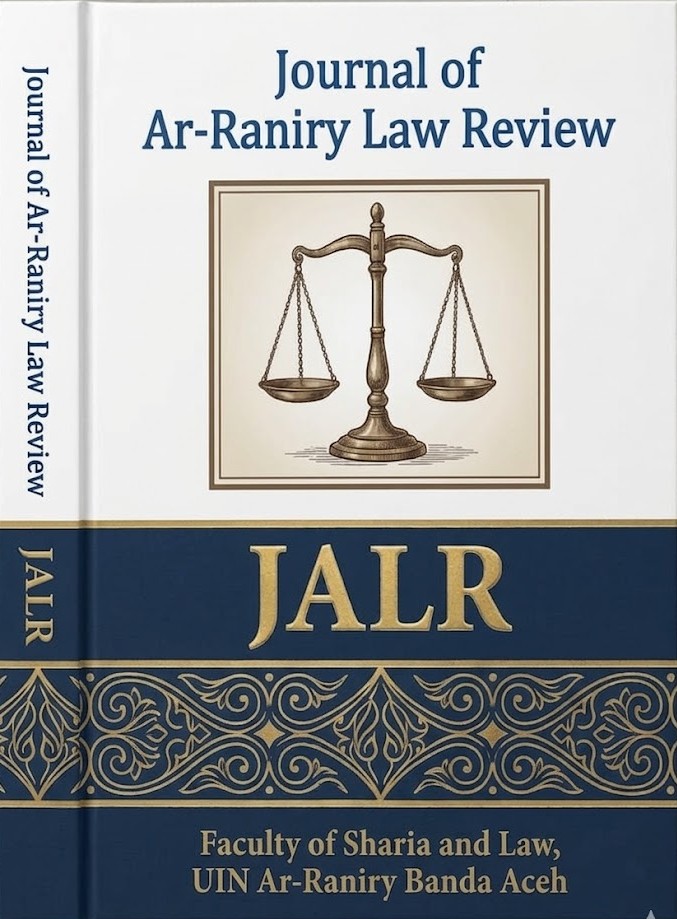
Journal of Tripa Law Review (TLR) is a peer-reviewed journal published biannually (June and December) by Fakultas Syariah dan Hukum, Universitas Islam Negeri Ar-Raniry. TLR has an online version (Online ISSN xxxx-xxxx). TLR aims to publish research results in law, both empirical and normative, especially on contemporary legal issues. The various topics include, but are not limited to, criminal law, constitutional law, private law, economic law, human rights law, international law, tax law, Islamic law, customary law, commercial business law, environmental law, street law, legal education, maritime law, and trade law in the framework of Indonesian legal systems and global legal studies.
PHILOSOPHICAL VALUES OF TRIPA LAW REVIEW
TRIPA Law Review is a scholarly legal journal that advances an integrative academic paradigm through the intersection of state law, Islamic law, and customary law as three distinct yet interconnected legal traditions. These traditions share historical, normative, philosophical, and sociological relationships that have significantly shaped the legal structures and social life of communities.
Philosophically, TRIPA symbolizes the convergence of three foundational pillars of legal traditions within a unified vision of justice, aimed at establishing a legal order that upholds legal certainty, public welfare (maṣlaḥah), human dignity, and social harmony. This interpretation constitutes an academic and philosophical conceptualization rather than an etymological claim concerning the historical origin of the name TRIPA.
The intellectual identity of TRIPA is deeply rooted in the rich legal heritage of Acehnese society, which historically demonstrates an enduring relationship between religious norms, customary traditions, and governmental authority. This relationship is reflected in the traditional Acehnese philosophical expression:
“Adat ngon hukom lagee zat ngon sifeut.”
This philosophical maxim illustrates the profound relationship between customary traditions and law, particularly law derived from Islamic teachings, as two closely interconnected dimensions of Acehnese social and legal life.
Within contemporary academic discourse, TRIPA extends this traditional philosophy into a dialogical, critical, and transformative approach to legal pluralism. The relationship between state law, Islamic law, and customary law is not understood as an inherently harmonious or uniform legal arrangement. Rather, it represents a dynamic field of interaction in which normative convergence, differences, and conflicts may arise, requiring objective and rigorous scholarly examination. Accordingly, TRIPA represents not only the distinctive legal and cultural identity of Aceh but also an intellectual framework for advancing legal scholarship with national and international relevance.
Epistemologically, TRIPA promotes a pluralistic and interdisciplinary approach to legal research that recognizes methodological diversity and encourages intellectual engagement across different legal traditions.
These approaches include normative or doctrinal legal research, empirical legal research, socio-legal studies, legal history, comparative law, legal anthropology, and scholarship in legal philosophy and jurisprudence.
TRIPA further encourages methodological dialogue among modern legal scholarship, Islamic legal methodology, and customary law research, while maintaining rigorous standards of academic inquiry, objectivity, methodological transparency, and scholarly integrity.
Through this epistemological orientation, the journal seeks to contribute to the development of legal knowledge that is theoretically informed, methodologically sound, and responsive to contemporary legal challenges. This philosophical position emphasizes that legal scholarship should not be confined to describing existing legal norms but should also critically evaluate their implications for individuals, communities, institutions, and society as a whole.
Universal Orientation and Global Justice
At the highest level, TRIPA promotes legal scholarship capable of connecting local legal experiences with broader national, regional, and international academic debates. This orientation provides opportunities for research addressing legal pluralism, human rights, international law, economic justice, Indigenous Peoples, democracy, digital transformation, climate change, and environmental justice.
Through this universal orientation, TRIPA seeks to bridge local legal traditions and global legal discourse, contributing to the development of legal scholarship that is inclusive, contextually grounded, and internationally relevant. As the foundation of its academic identity, TRIPA Law Review embraces seven core values that guide its intellectual orientation, scholarly publications, and contribution to the advancement of legal knowledge.
TRIPA Law Review — Rooted in Tradition, Advancing Justice Globally.
.
| Title | : | Journal of Tripa Law Review |
| Editor in Chief | : | Husni bin Abdul Jalil |
| ISSN | : | Print ISSN xxxx-xxxx, Online ISSN xxxx-xxxx |
| DOI Prefix | : | 10.22373/tripa.v1i1 |
| Publisher | : | Fakultas Syariah dan Hukum, Universitas Islam Negeri Ar-Raniry |
| Frequency | : | Biannually (June and December) |
ISSN: xxxx-xxxx (Online)
First Publication: 2026
Full English Language: 2026 - present
Publisher: Faculty of Law, UIN Ar-Raniry Banda Aceh, Indonesia
Duration: Approx. 30 days to the first decision
Acceptance Rate: 75% of the total submissions
Frequency: 2 (two) issues per year
DOI: 10.15294/tripa
Audience: Legal scholars, legal practitioners
Topic: Contemporary Issues on Law, Development, and Justice
Geographical Diversity: Indonesia, Malaysia, Australia, Germany
Indexing: googlescholar
Published: 2026-06-01

Karya ini dilisensikan di bawah Lisensi Internasional Creative Commons Atribusi-BerbagiSerupa 4.0.
© Hak Cipta dilindungi undang-undang 2026. TLR